
Get Solar Qualified With Our Smart Calculator!
GET ESTIMATE!Choosing a toothbrush mold in 2026 means balancing output, product design, and manufacturing cost. Buyers may compare single-cavity and multi-cavity molds, family molds, and hot-runner or cold-runner systems. Each option suits different production needs. A small factory testing a new handle shape may value lower upfront costs, while a high-volume producer may prioritize shorter cycles and consistent parts. Small details matter.
The right choice depends on more than cavity count. Consider the toothbrush’s handle geometry, material, surface finish, expected order volume, and available molding equipment. Ask suppliers about steel grade, mold-life estimates, cooling layout, maintenance access, and quality checks. Request sample parts where possible. A smooth handle can still hide uneven wall thickness or warping, so inspect fit and finish closely. Real production conditions can differ from a polished sample.
This guide reviews common toothbrush mold types and explains the trade-offs buyers should weigh before requesting quotes. It also highlights questions that help compare suppliers on practical evidence, not promises alone. No mold is ideal for every project. Even a detailed specification may need revision after the first trial; that is worth acknowledging early. With clear requirements and a careful review process, buyers can narrow their options and make a more informed decision for 2026.
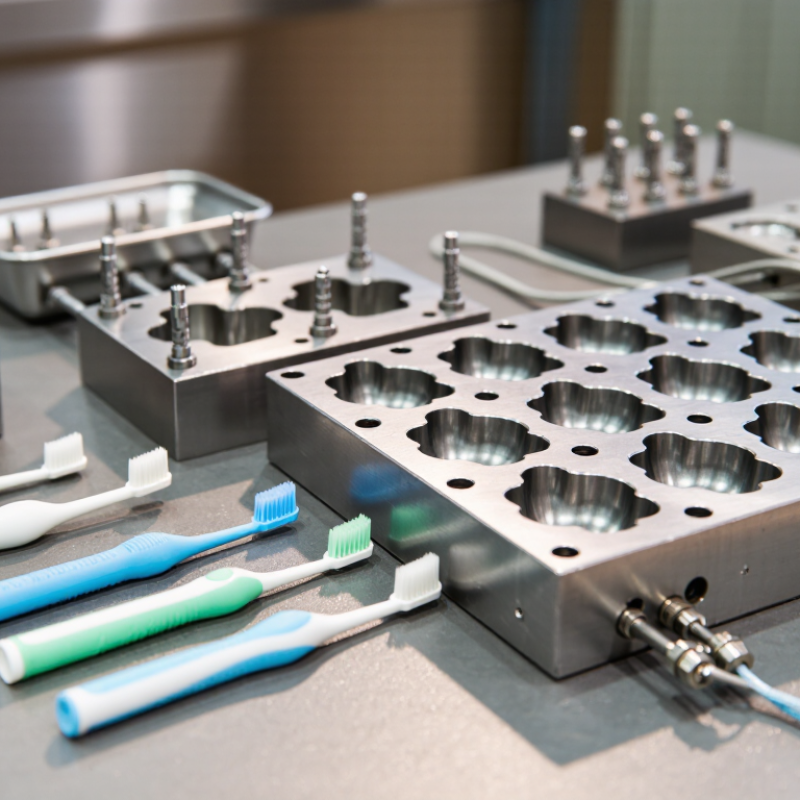
A toothbrush mold is a precision tool that shapes the plastic handle and head. It contains two main sections: a cavity and a core. Together, they form the toothbrush’s outer shape. In injection molding, plastic pellets are heated until molten, then pushed into the closed mold under pressure. Cooling channels help the plastic set. Ejector pins release the finished part. Small details matter: a raised grip pattern or thin neck can affect filling, cooling, and strength.
Many toothbrush handles use multi-cavity molds, which make several parts in one production cycle. The number of cavities depends on the design, machine capacity, and required output. Brush bristles are usually added through a separate tufting process, not formed by the handle mold. That distinction is easy to miss. Grand View Research estimated the global toothbrush market at about USD 7.28 billion in 2023; this is a product-market figure, not a mold-market estimate.
For buyers, mold quality shows up in consistent dimensions, clean edges, and stable production. ISO 20126:2022 sets requirements and test methods for manual toothbrushes, offering useful context for evaluating finished products. It does not prescribe one mold design. A smooth cavity surface can improve appearance, but it cannot fix poor material flow or an uneven cooling layout. Even experienced teams may need trial runs. Real parts can reveal issues that drawings miss.
Toothbrush handles are commonly made with single-cavity or multi-cavity injection molds. A single cavity suits early testing and lower volumes; multi-cavity tools produce several handles per cycle. More cavities can raise output, but only when cooling and filling remain balanced. Small differences matter. Family molds can form different components in one tool, though mismatched part sizes may complicate cycle control.
For soft grips, two-shot molds combine rigid plastic and elastomer in one process. Insert molds hold a separate component in place while plastic is injected around it.
Mold features also vary. Hot-runner systems keep plastic flowing through heated channels, while cold-runner systems solidify material in channels that may need trimming.
The Grand View Research Toothbrush Market report estimated the global market at USD 7.51 billion in 2023 and projected 7.4% annual growth from 2024 to 2030. That demand context helps explain interest in productive tooling, but it does not identify one best mold design. Product geometry, material choice, and acceptable scrap rates still guide selection.
Tips: Ask for a mold-flow review before approving production tooling. Check cavity balance, cooling near thick handle sections, and grip-to-handle bonding. A higher cavity count looks efficient on paper. It may not be.
Choosing between single-cavity and multi-cavity toothbrush molds depends on output needs, tooling budget, and production stability. A single-cavity mold makes one handle per injection cycle. It can suit pilot runs, changing designs, or limited press capacity. Tooling and sampling are often simpler to manage. However, the cost per handle may remain high as order volumes rise. That matters.
A multi-cavity mold produces several handles in one cycle, increasing output without requiring the same increase in machine time. But cavity count alone does not guarantee savings. Each cavity needs balanced filling, consistent cooling, and reliable ejection. If one cavity fills differently, handles may show uneven dimensions or surface marks. More cavities also mean more inspection points and potentially more involved maintenance. More output, more variables.
For buyers, compare expected annual volume with cycle time, machine capacity, and acceptable quality variation. Ask suppliers for sample parts from every cavity, not just one attractive handle. Check critical dimensions, flash, and gate marks under the same inspection method. A single-cavity tool may be the safer choice when designs are still changing. A multi-cavity option can make sense once demand and specifications are steady. The awkward part is that forecasts are rarely perfect, so a mold sized for maximum demand can sit underused.
Two-shot molding allows a toothbrush handle to combine rigid plastic with a softer grip in one production cycle. The first shot forms the strong handle core; the second adds a contrasting material around selected areas. This can create a cushioned thumb pad, textured side strips, or a soft section near the neck. The boundary between materials needs careful design. Poor material compatibility or uneven cooling can cause weak bonds and visible seams.
Insert molding takes a different route: a preformed component is placed inside the mold before plastic is injected around it. In a toothbrush, an insert might provide a distinct grip surface or support a slim, shaped handle. Accurate positioning matters. Even a small shift can leave the part uneven or affect its feel in the hand. Small details matter.
Both methods can support more expressive designs, but they add tooling and process demands. Two-shot molds require coordinated injection stages, while insert molds need reliable placement and retention. Material pairing should be tested for bonding, durability, and repeated wet use. Not every handle needs these features; a simpler mold may be more dependable and economical. It is easy to overdesign a grip before real users try it.
What Are the Top Toothbrush Mold Types for Buyers in 2026?
What Should Buyers Consider When Choosing a Toothbrush Mold in 2026?
A toothbrush mold should match the product, resin, and expected production volume—not just the lowest quoted price. For a simple handle, a single-cavity tool may offer easier adjustments and lower initial cost. Multi-cavity tools can raise output, but only if cooling and filling stay balanced across every cavity. Ask for trial-shot data: cycle time, part weight variation, and dimensional results. Fit matters. Check whether the mold’s venting and gate position leave flash or visible marks near the grip.
Material and maintenance deserve equal attention. The OECD’s Global Plastics Outlook reports that 353 million tonnes of plastic waste were generated worldwide in 2019, and only 9% was ultimately recycled. That figure is not a toothbrush-specific measure, but it makes resin efficiency and scrap tracking practical questions for buyers. Ask whether the mold can process your selected resin consistently, including any approved recycled content. Also request a clear maintenance schedule, spare-part list, and mold-life estimate based on documented cycles. ISO 20457:2018 provides guidance on dimensional tolerances for molded plastic parts; agree on critical dimensions before tool approval. One caution: impressive output claims mean little without trial data from your actual resin and handle design. A smaller tool may be the wiser choice.
| Mold Type | Typical Toothbrush Application | Main Advantages | Key Considerations for Buyers |
|---|---|---|---|
| Single-cavity mold | Prototypes, pilot runs, specialty designs, or products with lower demand. | Lower initial tooling complexity; simpler sampling and design changes. | Compare the lower tooling investment with the higher per-part machine time when production volumes grow. Confirm that the mold layout allows for future changes if the design is not yet finalized. |
| Multi-cavity mold | High-volume production of the same handle or component in one molding cycle. | Produces multiple parts per cycle and can reduce machine time per part at suitable production volumes. | Check cavity-to-cavity weight and dimension consistency, cooling balance, mold maintenance needs, and whether the available molding machine can support the mold’s size and clamping requirements. |
| Family mold | Different related components molded together, where their materials and processing requirements are compatible. | Can produce a matched set of components in the same cycle and may reduce the number of separate tools required. | Different part sizes or shapes can fill and cool unevenly. Confirm that each component’s required production quantity is aligned and that the mold can maintain acceptable quality across all cavities. |
| Cold-runner mold | Toothbrush handles or components where a conventional runner system is acceptable. | Generally straightforward in design and maintenance; suitable for many standard molding applications. | Runner material may need to be removed and managed after molding. Include runner waste, cycle time, and any permitted regrind in the cost and material plan. |
| Hot-runner mold | Production-focused multi-cavity tools, particularly where reducing runner waste is important. | Keeps resin in the runner system molten, avoiding a solid runner with each cycle and potentially improving material utilization. | Usually adds system cost and requires suitable temperature control and maintenance. Review gate vestige, material compatibility, color changes, and the supplier’s service plan. |
| Two-component or overmolding mold | Handles combining a rigid plastic body with a softer grip material, such as a compatible elastomer. | Can create a multi-material handle with an integrated soft-touch or grip area. | Confirm material bonding, shrinkage compatibility, and the required molding sequence. The tool and process are more complex than single-material molding; soft grip features are separate from the later bristle-tufting process. |
| Insert mold | Components that need a preformed insert—such as a compatible reinforcement or other functional element—encapsulated or supported by molded plastic. | Can combine an insert and molded plastic into one component when the product design requires it. | Assess insert positioning, retention, loading method, and the effect of the insert on cycle time and quality inspection. It is not necessary for a standard all-plastic toothbrush handle. |
© 2025 All Rights Reserved