
Get Solar Qualified With Our Smart Calculator!
GET ESTIMATE!Choosing the right J1772 charging station for a global buyer starts with a simple question: will it work safely and reliably with your vehicle and installation? J1772 is widely used for AC charging in North America, but connector compatibility, local electrical requirements, and vehicle equipment vary by market. Check the car’s inlet, the station’s connector, and the installer’s guidance before comparing power ratings. Small details matter. A cable that reaches the driveway, a clear status display, and dependable weather protection can shape everyday use more than a bold number on a product page.
EV charging reviewer Tom Moloughney’s practical work points toward a useful principle: match charging equipment to the vehicle, electrical supply, and daily routine. This is an editorial paraphrase, not a verified verbatim quotation. That distinction matters when choosing advice online. For this guide, we will look beyond marketing claims and compare output, safety features, cable design, warranty coverage, and support availability. Buyers should also confirm that a model is approved for use in their location and installed by a qualified professional. A high-power unit cannot exceed the limits of the vehicle or circuit. Not always better. The best choice is the one that fits the actual setup, not an imagined future one. We will highlight practical trade-offs, including where specifications may look impressive but offer little benefit at home. Some recommendations depend on the car and installation. Use the checklist as a starting point, then verify the details with the manufacturer and installer.
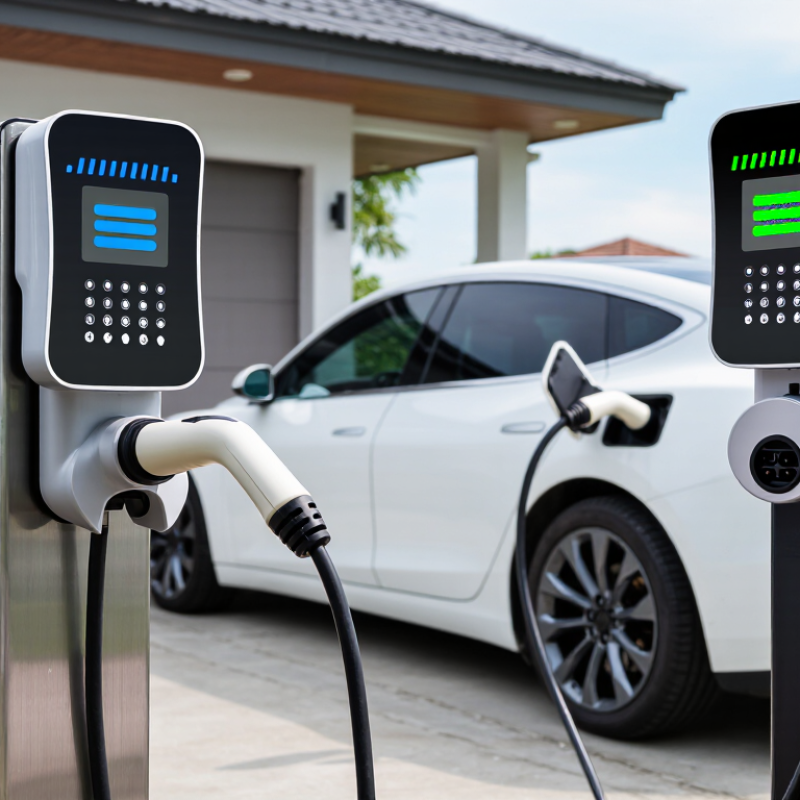
J1772, commonly called Type 1, is an AC connector used for SAE Level 2 charging. The charger supplies AC power; the vehicle’s onboard charger converts it for the battery. Under the J1772 specification, Level 2 can reach 240 volts and 80 amps, or 19.2 kW. That is a maximum, not a typical promise.
The U.S. Department of Energy’s Alternative Fuels Data Center describes Level 2 equipment as operating at 208 or 240 volts and adding roughly 10–20 miles of range per hour. Actual results vary. A vehicle’s onboard charger, available circuit, cable rating, and battery temperature can all limit power. A 19.2-kW label is a ceiling. Many cars accept much less on AC.
The International Energy Agency’s Global EV Outlook 2024 reports that public charging points exceeded 4 million worldwide in 2023, growing by more than 40% that year. That growth does not guarantee connector compatibility. Type 1 is not universal, so global buyers should check the vehicle inlet and local supply before choosing a station. It is an easy detail to miss.
For global buyers, “J1772” usually refers to the Type 1 AC connector widely used in North America. It is not a universal plug. A vehicle from another market may have a Type 2 inlet under IEC 62196, with a different shape and pin layout. Check the vehicle’s charge-port label and the station’s cable end; photos can hide small differences. Fit matters. A mismatched plug will not connect directly, and an adapter should not be treated as a cure-all. Confirm that both the vehicle and charging equipment support the intended AC supply and charging rate.
Type 2 is common across many IEC-based markets and can support single-phase or three-phase AC when both the car and station allow it. Type 1 is generally used for single-phase AC. That difference can affect charging speed, but the connector alone does not tell the whole story. Onboard charger limits, circuit capacity, and local voltage matter too. Check the exact product documentation before buying, especially for imported vehicles or workplace fleets. Check the label. Some listings use “J1772” loosely, which can create confusion; I would verify the connector standard and cable configuration in writing. Regional equipment varies, so assumptions can be costly.
A 240 V supply at 80 A can deliver up to 19.2 kW of AC power. That is the ceiling. Actual charging speed depends on the vehicle’s onboard charger, so a car limited to 11 kW will not use the station’s full output. Voltage can also vary under load, and long cable runs may introduce a small drop. Check the vehicle specifications before planning around the headline figure.
An 80 A charging load needs careful electrical planning. In many installations, the circuit must be rated above the charging current because charging is a sustained load; a qualified electrician can confirm the appropriate wiring, breaker, and service capacity for the site. The station’s rating alone does not guarantee that a building can support it. A practical check is to review the electrical panel and other large loads, such as heating or cooking equipment, during the hours charging is expected.
For global buyers, connector fit is only part of compatibility. J1772 is used in several markets, but local vehicle inlets, supply voltage, and installation practices differ. Confirm each one. A little planning here can prevent an expensive mismatch, though it is easy to overlook one detail when comparing power ratings.
| Planning Dimension | Practical Data | What Buyers Should Check |
|---|---|---|
| Connector standard | SAE J1772 (Type 1) is an AC charging connector commonly used in North America and some other markets. | Confirm that the vehicle inlet matches J1772. Many vehicles in other regions use different connector standards, so compatibility should be verified before purchase. |
| Reference supply voltage | 240 V AC is the reference voltage used for the headline power calculation. | Check the site's actual voltage and electrical service. A nominal 230 V supply will produce a different power level from 240 V at the same current. |
| Maximum stated output | At 240 V and 80 A: 240 × 80 = 19,200 W, or 19.2 kW. | This is a theoretical AC output figure. Delivered charging power can be lower because of supply conditions, equipment settings, or the vehicle's onboard charger. |
| Example at 230 V | At 230 V and 80 A: 230 × 80 = 18.4 kW. | Use the site's measured or nominal voltage when estimating output; do not assume every 230 V installation can support 80 A. |
| Example at 208 V | At 208 V and 80 A: 208 × 80 = 16.64 kW. | Some commercial supplies operate at 208 V. Verify that the charging equipment is designed for the available supply and configured accordingly. |
| Circuit planning for 80 A charging | In installations governed by the U.S. NEC, EV charging is treated as a continuous load; an 80 A charging load generally requires a circuit rated for at least 100 A. | Electrical requirements vary by jurisdiction and installation. Have a qualified electrician confirm conductor sizing, overcurrent protection, and local code compliance. |
| Vehicle charging limit | The vehicle's onboard AC charger sets the maximum AC charging power it can accept. | An 80 A charging station does not mean every vehicle will charge at 80 A. Check the vehicle specifications for its maximum AC input current and power. |
| Site and installation | Available service capacity, wiring distance, temperature, and installation method can affect the feasible continuous current. | Assess the electrical panel and site load before selecting an output rating. Load management may be needed where service capacity is limited. |
| Global compatibility | J1772 is not a universal connector standard for all countries or vehicles. | Confirm connector type, supply voltage, frequency, local certification, and any permitted adapter use for the specific vehicle and destination market. |
| Key takeaway | An 80 A J1772 unit can deliver up to 19.2 kW at 240 V, but actual charging speed depends on the supply, installation, equipment configuration, and vehicle onboard charger. | |
For global buyers, a J1772 charging station should be judged by documented safety evidence, not a label alone. UL 2594 covers electric vehicle supply equipment safety in the United States; check that certification applies to the exact model and configuration. IEC 61851 is a family of standards for conductive charging systems, with different parts covering equipment and operation. These references are not interchangeable. A unit assessed under one framework may still need approval for its destination market.
Ground-fault protection deserves a close look. Check the manual for the protection method, trip behavior, and required upstream breaker; terminology can vary by region. Ask whether the station detects residual current and DC leakage, and whether an additional protective device is required locally. Have a qualified installer verify grounding, conductor size, and the circuit before energizing the unit. A neat enclosure proves little. Inspect the cable strain relief and connector for cracks or a loose fit. Small details matter. Paperwork can be confusing, and a checklist cannot replace an installation review. Keep certification documents, installation records, and test results together for future service.
A J1772 charging station does not set the vehicle’s full charging speed. The car’s onboard charger converts AC power and limits how much current it can accept. Check its rated amperage or kilowatt capacity in the vehicle manual. Then compare that figure with the EVSE’s maximum output and the electrical circuit’s capacity. That matters.
For example, at 240 volts, a vehicle accepting 30 amps can draw about 7.2 kW. A 32-amp EVSE may suit it, but the car still sets the limit. A vehicle rated for 48 amps could use more power only if the station and properly sized circuit support it. Higher numbers are not automatically better. One easy mistake is reading an EVSE’s peak rating as a promise of faster charging.
For global buyers, verify the supply voltage, connector compatibility, and installation requirements for the intended location. The same amperage can deliver different power at different voltages. Ask a qualified local electrician to confirm the circuit and applicable installation rules before purchase. Also check whether the vehicle’s stated onboard-charger rating applies to AC charging. A little uncertainty remains: charging speed can vary with temperature, battery state, and vehicle settings, so the published maximum may not appear in every session.
© 2025 All Rights Reserved